


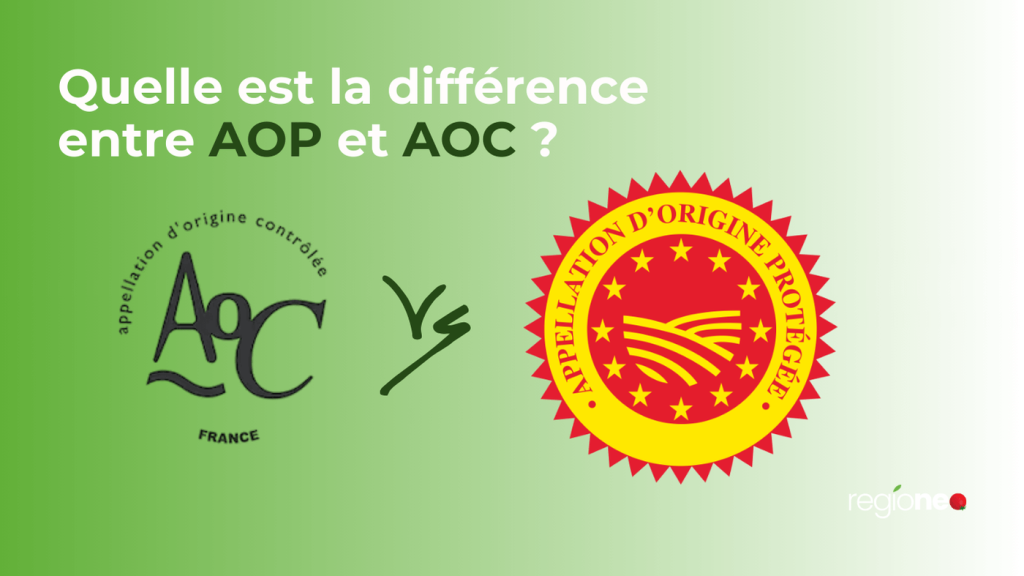
In the world of regional produce, some Food labels play an essential role in guaranteeing origin, quality, and adherence to traditional know-how. Among them, two markers regularly appear on cheeses, wines, oils, and cured meats: The AOC and The AOP.
These designations, governed by the INAO and recognised as official quality labels, allow consumers to identify products closely linked to their region. However, despite their familiar presence on our labels, their exact meaning and specificities often remain unclear.
Before making a distinction between these two terms, it is essential to review their origin.
What is AOC?
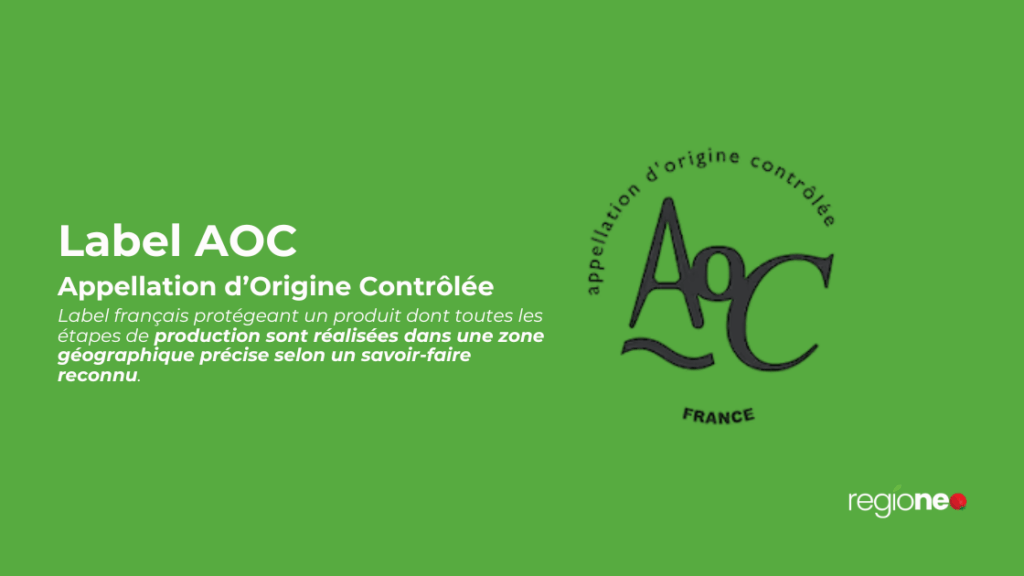
L’Appellation d’Origine Contrôlée (AOC) is an official French label guaranteeing that a product derives its characteristics from a precisely delimited terroir and of a recognised traditional know-how. Managed by the INAO, it is one of the oldest and most demanding signs of origin in the French food landscape.
Established in 1935, the AOC (Appellation d'Origine Contrôlée) was born out of a desire to protect French agricultural produce from counterfeiting, particularly in the wine sector. It was later extended to other products such as cheeses, butters, and certain oils.
This approach is based on a central principle: The geographical origin directly influences the qualities of the product.
The AOC protects the product's name only in France. It applies to several categories, including certain sectors not covered by European regulations, for example wood. Many emblematic products benefit from this label, particularly in the cheese sector: Roquefort, Brie de Meaux, Camembert de Normandie, Reblochon and Comté.
What is AOP?
L’Protected Designation of Origin (PDO) is a label European created in 1992 which guarantees that a product is entirely produced in a defined geographical area, according to recognised and strictly regulated expertise.
It represents the highest level of protection concerning the origin of a food product within the European Union. The PDO protects the name of a product throughout the European Union and all production stages must come from a precisely defined terroir.
Unlike the AOC, which is limited to French territory, the AOP offers legal protection throughout the European Union, preventing the misuse of the product name in all Member States.
AOC vs AOP: The Differences in Depth
Even though both labels are based on the same principle, a product whose qualities stem from a defined region and recognised expertise, the’AOC and the’AOP do not operate at the same level and do not confer the same legal scope.
Geographical scope: France vs Europe
One of the major differences lies in the scope:
– The AOC protects a product only within French territory.,
– The PDO protects the product's name throughout the European Union, ensuring harmonised protection across all Member States.
This distinction influences not only product visibility but also how it is defended against fakes.
Legal framework and recognition
L’AOC relies on a strictly French framework, defined and governed by the INAO. Certain products not covered by European law, such as wood, can be protected under AOC.
L’AOP, it, stems from European Regulation 1151/2012, which aims to harmonise quality systems, strengthen the protection of designations, and ensure fair competition between European producers.
Obtaining process: AOC succession → AOP
L’AOC is a mandatory step Before a product can be registered as a PDO at European level, the designation must first be recognised nationally before being submitted to the European Commission for wider recognition.
This progressive passage guarantees continuity between French recognition and European protection.
Affected products and exceptions
The two labels cover similar categories (cheeses, wines, oils, cured meats…), but some differences exist:
– The’AOP covers a wider range of products, including some non-food items.
– The wine are a special case: even when registered as PDOs, they can continue to display the mention AOC if they wish.
| Criterion | AOC | AOP |
| Geographical scope | Territorial protection French only | Protection in the entire European Union |
| Competent authority | INAO (National Inventory of Architectural Heritage) | European Commission + INAO (for the national part) |
| Legal basis | French framework specific to high-quality food products | EU Regulation No 1151/2012 (harmonised framework) |
| Obtaining process | First mandatory step before an AOP application | European reconnaissance after AOC validation |
| Types of products concerned | Food products + areas not covered by the EU (e.g. wood) | Food products and certain non-food products (e.g. Crau hay) |
| Link to the land | Strong, defined by strict specifications | Identical, with European-level validation |
In conclusion
The labels AOC and AOP are two major benchmarks for identifying products closely linked to their terroir and traditional manufacturing methods. Regulated by the INAO and recognised as official quality marks, they guarantee a high level of stringency for both producers and consumers.
This means that each product bearing one of these labels respects precise, validated, and regularly verified methods.
For the consumer, it's the assurance of a Authentic product, whose origin and manufacturing methods are clearly identified.
For producers, these labels are a way of preserving local heritage, to defend their know-how and be protected against imitations.
By highlighting the link between product, region and tradition, these quality marks help to support local sectors committed to demanding and identifiable production.
FAQ
La principale différence entre l’AOC et l’AOP réside dans le fait que l'AOC est une appellation française qui a été remplacée par l'AOP au niveau européen. L'AOP est une indication géographique protégée qui garantit que le produit a été fabriqué dans une région spécifique et qu'il respecte des normes de qualité particulières.
The AOC is a French label, while the AOP applies the same principles but on a European Union scale, offering broader protection for denominations.
Une AOP est l'équivalent français d'une AOC.
Not automatically, but the AOC is a mandatory preliminary step before potential PDO recognition, as indicated by INAO.
Are AOP products always of better quality than AOC products?
Quality is built on the same foundation: strict specifications and a strong link to the land. The AOP is not a “higher level”, but a wider geographical scope of protection.
Can I find a PDO outside of Europe?
The protection is European, but AOP products can of course be sold in other countries. What changes is the Legal scope it applies strictly in the EU, in accordance with the European legal framework described in Regulation 1151/2012.