


Buying vegetables directly from a producer at a market, collecting a basket ordered online from local farmers, subscribing to a CSA (Community Supported Agriculture)... These practices, which are increasingly common, all follow the same principle: short supply chains.
Often associated with «local» or «direct sales,» the short supply chain is nevertheless a precise and sometimes misunderstood concept. So, what exactly is a short supply chain and what forms can it take?
What is a short supply chain?
A short supply chain is a method of marketing agricultural products in which There is no or at most one intermediary between the producer and the consumer..
This term therefore refers to a shortened distribution chain, where the product goes directly from the field to the plate, or almost.
Concrètement, buying tomatoes from a market gardener at the market is a short supply chain. Ordering a vegetable basket via a Platform connecting producers and consumers directly, it's also a short circuit.
Official definition of short supply chains?
In France, the reference definition was established by the Ministry of Agriculture, Food and Fisheries as part of the short supply chain support plan launched in 2009.
According to this definition, a short circuit is « a method of marketing agricultural products that is carried out either by direct sale from producer to consumer, or by indirect sale, provided that there is only one intermediary ».
This definition is based on a single criterion: the number of commercial intermediaries, which must not exceed one.
What the official definition does not imply
Two confusions deserve to be dispelled:
- Circuit court ≠ local product.
The administrative definition does not take geographical distance into account. Thus, oranges grown in Spain, imported by a single intermediary and sold to a French consumer can be considered a short supply chain in the strict sense.
The short circuit therefore does not necessarily imply geographical proximity, even if, in practice, the two notions are often associated.
- Circuit court is not direct selling.
Direct selling involves zero intermediaries between the producer and the consumer. Short supply chains, on the other hand, allow for up to one intermediary. All direct sales are short circuits, but not all short circuits are direct sales..
An artisan butcher who buys their meat from a local farmer and sells it to the consumer operates in a short supply chain, without it being direct sales.
How does a short circuit work?
The principle of a short supply chain is simple: to minimise the number of steps between the producer and the consumer. To understand how it works, we need to identify the three possible actors in this system.
The actors in a short supply chain
The producer is at the start of the chain. This could be a farmer, a livestock farmer, a winegrower, a beekeeper, or a craftsman processor (e.g. a farmhouse baker, cheesemaker, etc.). They are the ones who cultivate, harvest, or make the product that is put up for sale.
The consumer is at the end of the chain. This is the final customer, the one who buys the product to consume it. In short circuits, they are in direct or almost direct contact with the producer, which allows them to better know the origin of what they are eating.
The potential intermediary is the optional link that can be inserted between the two. Its role is to Facilitate connection, logistics, or sales., without, however, constituting an opaque screen between producer and consumer.
The role of the single intermediary
When it exists, the short-circuit intermediary performs a relay function: it can store, distribute, stock shelves, or ensure delivery logistics. This is the case for a producer shop, an independent local grocery store, a restaurateur who sources from local farmers, or even a digital platform that facilitates online ordering, such as Regioneo.
In a traditional long supply chain, a product can go through a wholesaler, a purchasing centre, a logistics provider, and then a distributor before arriving on the shelves. This involves four to five intermediaries, each taking a margin. In a short supply chain, the chain is reduced to a minimum, allowing the producer to retain a larger share of the final price.
What forms can a short food supply chain take?
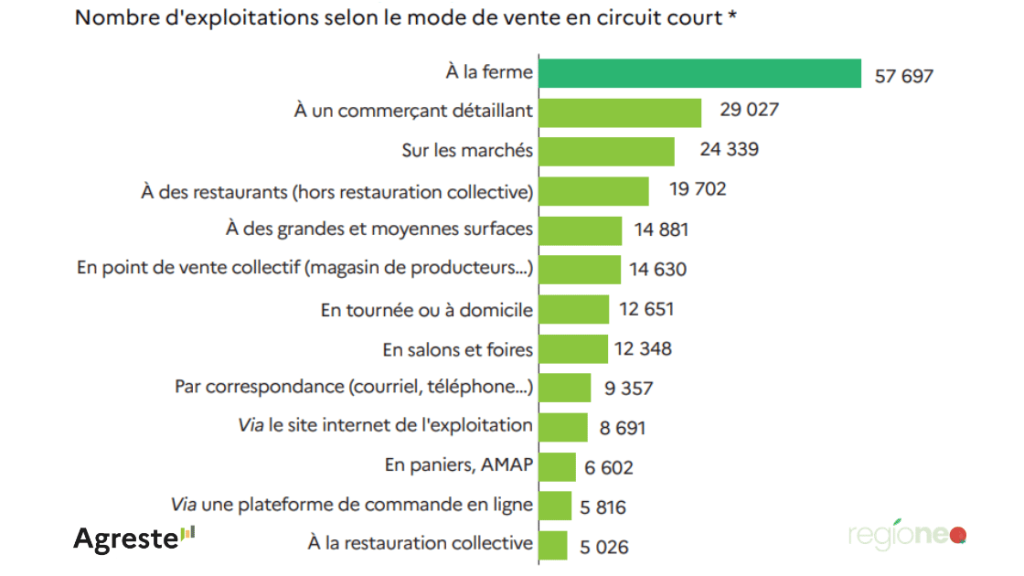
Agreste – Agricultural Census 2020
Short food supply chains are not a one-size-fits-all model. They encompass very diverse realities, which can be classified into two broad categories.
Direct sales (no intermediaries)
This is the most intuitive form of short supply chains. The producer sells their products directly to the final consumer, without any commercial third parties.
Farm shop is the oldest model: the consumer visits the farm to buy directly from the producer. This can take the form of a farm shop, a pick-your-own system («farm picking»), or organised visits with on-site sales.
Open-air markets In France, there are approximately 8,000 markets spread across 6,000 municipalities. Producers set up their stalls there and deal directly with buyers. The relational aspect is strong: regulars know their greengrocer, their cheesemonger, their beekeeper.
AMAP (Associations pour le Maintien d’une Agriculture Paysanne) rest on a reciprocal commitment: a group of consumers subscribes in advance to receive a weekly basket of produce, thereby guaranteeing a stable income for the producer. This system, which emerged in France in the early 2000s, has played a major role in the revival of short supply chains.
Farm vending machines, farmer's markets and direct online sales from the producer's website complete this picture.
Selling with an intermediary
When only one intermediary is placed between the producer and the consumer, it remains a short supply chain while still benefiting from more structured logistics.
Farm shops are collective retail outlets where several farmers join forces to market their produce together. The Rural Code sets out the framework for these structures: produce from member farms must account for at least 70 % of the shop’s turnover. These shops operate as a single, shared intermediary.
Local grocery stores and independent shops (butchers, cheesemongers, wine merchants, etc.) play a role in selecting and highlighting the products of their region. A butcher who sources exclusively from local farmers and sells directly to the end consumer is part of the short supply chain.
Local digital platforms represent a contemporary form of short supply chains. They connect producers and consumers via a digital tool, facilitating ordering and sometimes logistics (click & collect, collection points). It is in this category that solutions like Regioneo are found, offering fruit and vegetable producers an e-commerce tool dedicated to direct sales, integrating order management, collection slots, and the promotion of anti-waste products.
How to recognise a short-circuit product?
To date, there are no Official label «In France, the term »circuit court" (short supply chain) is not protected by a formal certification. Unlike organic labels (AB, Eurofeuille) or appellations of origin (AOP, IGP), no certification formally guarantees that a product has been sold through a short supply chain. Therefore, assurance relies largely on trust and transparency.
However, there are a few landmarks to help you find your way.
- Identify the seller: at a market, ask if they are a producer or a reseller. A producer selling directly can explain their farm, their methods, and their production.
- Check the labelling: the terms «farmhouse» or «producer's» must reflect reality. In producer shops, the identity of the producer and the origin of the product must be clearly displayed.
- Ask the right questions: where does the product come from? Who grew or made it? How many intermediaries has it passed through?
- Identify institutional mentions: platforms such as «Frais et local», networks «Bienvenue à la ferme» or labelled farm shops.
What is the link between short supply chains and local platforms like Regioneo?
The short supply chain is a distribution model, but its implementation requires tools adapted to current realities: order management, collection organisation, online payment, visibility.
It is within this framework that local platforms such as Regioneo operate.
Developed as part of the European SISTERS project (Horizon 2020) and recognised by the European Commission's Innovation Radar, Regioneo offers fruit and vegetable producers a dedicated e-commerce site, integrating order management, pick-up slots, delivery zones, and the valuation of anti-waste products.