






Permaculture is experiencing remarkable growth in France and around the world.
Faced with current ecological challenges soil exhaustion, loss of biodiversity, food waste, Furthermore, an increasing number of producers, amateur gardeners, and citizens are turning to this approach, which reconciles agriculture, nature, and common sense.
But What is permaculture and how does it fit into an approach of Sustainable local production We'll explain everything to you.
What is permaculture? Definition
The word permaculture is a contraction of« permanent culture » or « Permaculture ».
This concept was theorised in the 1970s by the Australian Bill Mollison, a biologist, and his student David Holmgren, writer and designer. They drew inspiration from the work of Japanese farmer Masanobu Fukuoka, a pioneering figure in natural agriculture.
According to the Larousse dictionary, permaculture is « A mode of agriculture founded on the principles of sustainable development, aiming to be respectful of biodiversity and humanity, and consisting of imitating the functioning of natural ecosystems. ».
But this definition, centred on agriculture, does not account for the full richness of the concept.
Permaculture is, first and foremost, a design philosophy. It encourages us to observe nature and draw inspiration from its workings in order to replicate its cycles, interdependencies, and lack of waste. This approach can be applied to all areas of life, whether it be in the garden, housing, the local economy, or social organisation.
The three founding ethics of permaculture
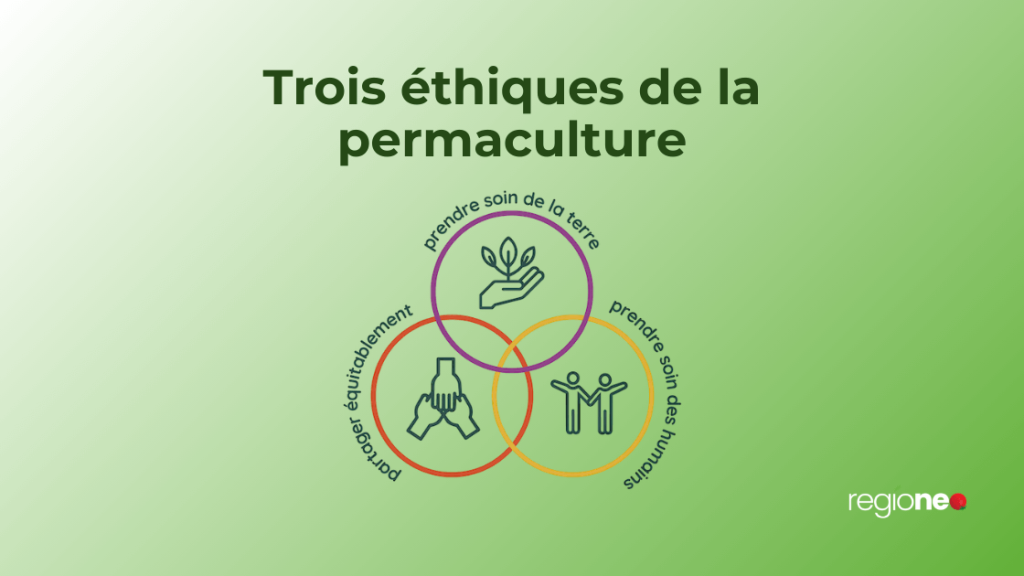
The entire permaculture approach is based on three ethics fundamental, formulated by Bill Mollison and David Holmgren. These are the values that guide every design decision.
1. Taking care of the EarthEarth Care)
The Earth is the foundation of all life. Permaculture is based on the principle that soil, water, air and living organisms in general must be preserved and regenerated, rather than exploited to the point of depletion. This involves protecting biodiversity, avoiding synthetic chemicals, and nourishing the soil rather than depleting it.
2. Caring for menPeople Care)
A sustainable society can only be built by ensuring the well-being of its members. This ethic reminds us that production systems must meet people's fundamental needs, such as healthy food, access to water, and housing, without exploitation or exclusion.
3. Share fairlyFair Share)
The Earth's resources are not infinite. Permaculture encourages producing what we need, redistributing surpluses rather than hoarding them, and reinvesting profits into projects that reinforce the first two ethics. This is the ethic of «returning surplus».
The 12 principles of permaculture design
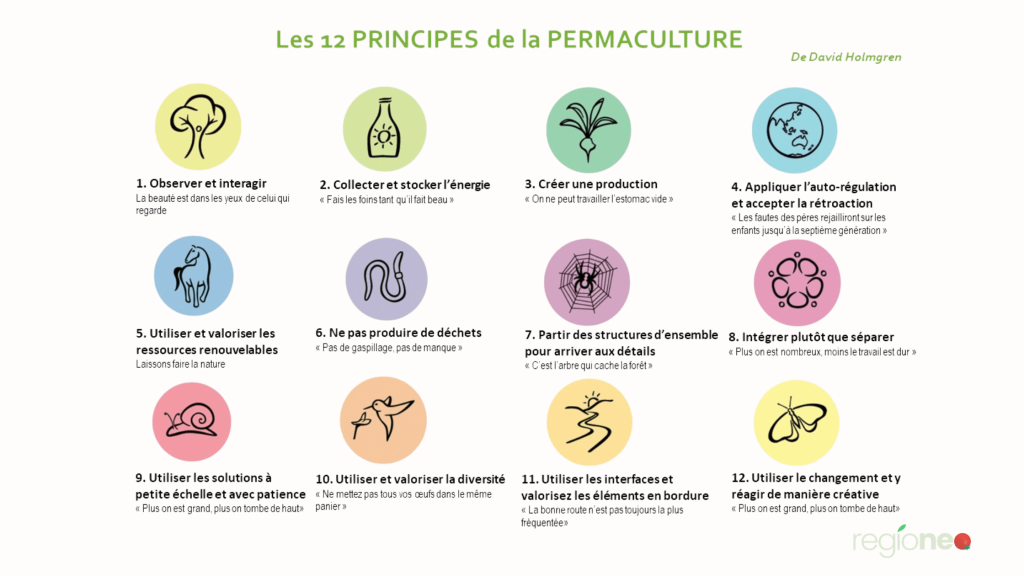
David Holmgren formalised 12 principles of design which allow for the implementation of permaculture ethics in practice, whether in the garden, on the farm, or in any other organisation.
1. Observe and interact
Before acting, one must carefully observe their surroundings: how the wind blows, where water stagnates, which insects are present, how the light changes with the seasons. This meticulous observation allows for decisions to be made that are adapted to each context, rather than applying ready-made recipes.
2. Capture and store energy
Nature is bursting with energy: sun, wind, water, nutrients… Much of it remains unused. Permaculture encourages the creation of systems capable of capturing and storing these resources when they are available, so that they can be enjoyed during times of scarcity.
3. Obtain a production
All work must produce a useful outcome. This principle encourages directing every effort towards concrete and measurable benefits. It also invites us to verify that the systems created are genuinely productive, whether in terms of vegetables, energy, or services rendered to ecosystems.
4. Apply self-regulation and accept feedback
Natural systems self-regulate. When a species becomes too abundant, a predator intervenes and balance is restored.
In permaculture, we aim to design systems capable of acting in the same way.
Feedback signals, such as failure, illness, or deficiency, are not seen as problems to be eliminated. They are valuable information that helps to improve the system.
5. Use and value renewable resources and services
Promote natural and renewable resources as much as possible. This includes solar energy, rainwater, green fertilisers, and farm animals. The idea is to reduce dependence on industrial inputs, which are often costly and energy-intensive.
6. Produce no waste
In nature, there is no waste: dead leaves become humus, the carcass of an animal feeds scavengers, then insects, then the earth. Permaculture strives to close loops: each «waste product» is a resource for another element of the system.
This principle particularly resonates with Regioneo's mission, a platform dedicated to local producers fighting food waste by making use of their unsold goods, their «ugly» fruit and vegetables, and their surplus production.
7. Design from global structures to details
Before planting the first seed, you must design the entire system: the zones, the flows, the connections between the elements. This is the opposite of a siloed vision. In permaculture, we first think about the relationships between the components, then we refine the details.
8. Integrate rather than separate
Each element of a permaculture system performs multiple functions, and each function is supported by multiple elements. For example, a chicken coop integrated into a garden fertilises the soil, scratches out pest insects, produces eggs, and generates heat without external inputs.
9. Use slow, small-scale solutions
Start small, observe, adjust. Small-scale solutions are easier to manage, less risky, and often more effective in the long run than large industrial installations. Permaculture values slowness as a quality, not a fault.
10. Use and value diversity
Intensive monoculture is fragile. A single disease can be enough to destroy an entire crop.
Diversity, whether of species, varieties, techniques or even income sources, strengthens the resilience of systems.
In permaculture, we therefore favour plant associations, polycultures and hedgerows.
11. Utilising field margins and enhancing marginal areas
Edges are areas where two environments meet, for example between a forest and a meadow, or between water and dry land. These are spaces particularly rich in biodiversity.
This principle invites us to pay attention to these often-overlooked areas and to value the margins of a plot rather than ignore them.
12. Use change and respond with creativity
Change is inevitable. Permaculture therefore does not seek to freeze systems. It aims instead to make them sufficiently flexible to adapt to any evolution. This could be climate change, sudden drought, or a change in the local market.
Permaculture in practice: what does it look like in reality?
Permaculture translates to a set of Techniques and layouts which are often found in permaculture farms and gardens:
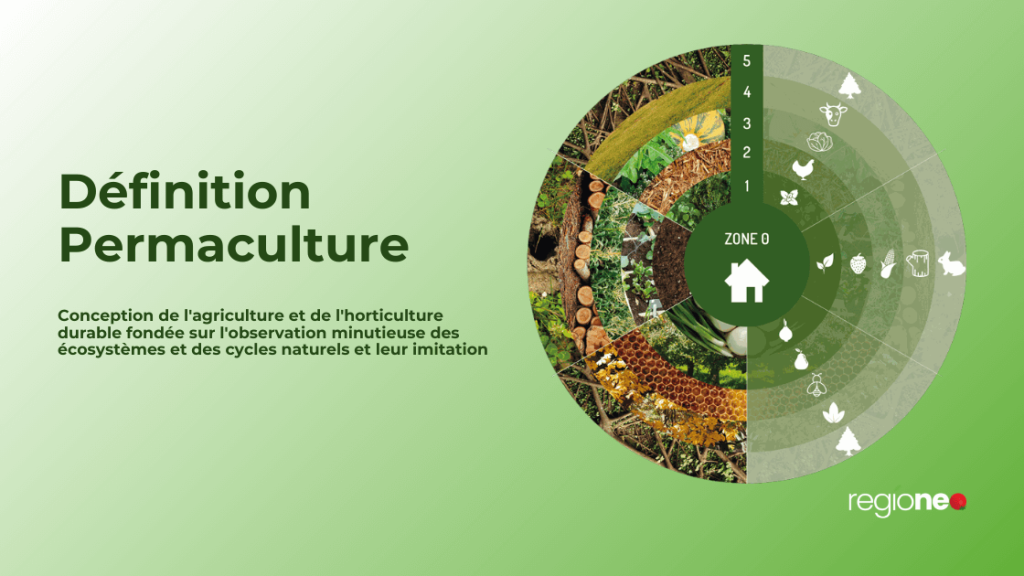
Zoning and sector design. The space is organised into concentric zones according to frequency of use: zone 0 is the home, zone 1 is the vegetable patch requiring daily care, zone 5 is the wild forest left to its own devices. This zoning optimises travel and energy expended.
Growing beds (lasagne beds, woody ramial beds). These above-ground structures allow for the rapid creation of fertile soil, even on poor land, by layering organic matter.
The forest garden. Inspired by primeval forests, the forest garden replicates a multi-layered structure (fruit trees, shrubs, ground cover plants, climbers) that is entirely edible and almost self-managing.
Agroforestry. The association of trees with crops or livestock on the same plot, a practice that improves soil structure, reduces erosion and creates favourable microclimates.
Mulching and no-till. Covering the soil rather than leaving it bare, and not tilling it to preserve its structure and microbial life – these practices are at the heart of regenerative agriculture.
Rainwater harvesting and swales. Adaptations to capture water where it falls and allow it to infiltrate slowly into the soil, rather than letting it run off and erode the land.
Permaculture and short food supply chains: a natural convergence
Permaculture and local sales share the same fundamental values: Produce locally, limit intermediaries, value each resource, reduce waste. A market gardener who applies the principles of permaculture will naturally seek to sell directly to their neighbours or their community, in order to capture the full value of their work and prevent unsold produce from ending up in the bin.
It is precisely this logic that Regioneo accompanies: enabling local fruit and vegetable producers to easily market their produce online – including «ugly» produce, surplus stock, and anti-waste offers – by launching their own e-commerce shop in under a day.
Permaculture produces less waste; Regioneo ensures that unsold items don't become waste. An obvious complementarity for building truly sustainable local food systems.
Permaculture and organic farming: what are the differences?
We often confuse Permaculture and organic farming. While these two approaches share common values such as the rejection of chemical pesticides and respect for the environment, they are not identical.
méthode de production agricole. Certification governed by a regulatory specification (the AB label in France). It defines what is forbidden to use (synthetic pesticides, GMOs, chemical fertilisers), but it does not prescribe a design method or an overall philosophy.
Permaculture, on the other hand, is a Design philosophy She goes further by proposing a systemic vision of the farm or garden.
A permaculture farmer may or may not be certified organic, but their practices will generally be compatible with, or even more demanding than, organic standards.
Common misconceptions about permaculture
«Permaculture is like wild, unproductive gardening.» False. A well-designed permaculture system can be extremely productive. It requires more upfront thought, but less physical work and fewer inputs in the long term.
« Permaculture only works for small gardens. » Also false. Commercial market gardens, agroforestry operations, and even businesses are applying permaculture principles on a large scale.
«Permaculture is a recent fad.» Its roots go back to the 1970s, but some of its principles have been practised for millennia by indigenous peoples around the world.
Key takeaways
Permaculture is much more than a gardening technique: it is a philosophy of life and design that proposes to reintegrate humans into their ecosystem rather than abstract them from it. Founded on three ethics — earth care, people care, fair share — and twelve universal design principles, it offers a concrete framework for sustainable production, regenerating soils and ecosystems, and building resilient food communities.
For local producers, permaculture and direct sales are two sides of the same coin: better production, fair sales, no waste. Values that Regioneo puts at the heart of its platform every day.
You are a fruit and vegetable producer and you want to develop your direct sales while reducing unsold produce? Discover how Regioneo can help you.
FAQ
Is permaculture officially recognised in France?
There is no regulated «permaculture» certification in France. You can train with associations, obtain a Permaculture Design Certificate (PDC), and join networks of practitioners, but permaculture is not an official label.
Can permaculture be done in an apartment or in a city?
Yes. The Urban permaculture is a movement in its own right: vegetable patch balconies, vermicomposting, participating in shared gardens, reducing food waste.
How long does it take for a permaculture garden to be productive?
The first few years are dedicated to building the soil and structures. A permaculture garden is generally considered to reach its full maturity and Productivity after 3 to 7 years depending on the techniques used.
What is the link between permaculture and locally sourced food?
A permaculture system produces local food, often in polyculture, with very few external inputs. This local production, sold through short supply chains, helps to reduce the carbon footprint of food and to strengthen the food autonomy of territories.